Henry Stanley was my great,great grandfather. My article in the History Armagh magazine in 2025 was entitled Henry Stanley: Life as a Dispensary Doctor and Police Surgeon in County Armagh. You can find the article online at the Armagh History Group website at History Armagh 2025 on pages 31-36.
This site is under construction and as such some features are not working. The content below displays 3 of the most recent posts on the site.
-
The History of the Bindon Family of County Clare, Ireland: Tracing the Legacy of a Noteworthy Irish Lineage.
Please note this post was created by Copilot in Microsoft Word, the accuracy of the result is very dependent on the availability and accuracy of online records. Fortunately in this instance some such records exist. It took less than 5 minutes to produce.
Introduction
The history of Ireland is intricately woven with the stories of its many families, each contributing uniquely to the fabric of its past. One such family, though less frequently mentioned than the great Gaelic clans, is the Bindon family of County Clare. The Bindons, of Anglo-Irish descent, were both witnesses to and participants in the defining moments of Irish history. Their journey from settlers to prominent gentry, and their legacy through politics, architecture, and society, offer a fascinating glimpse into the evolution of Ireland from the seventeenth century onwards.
Origins and Arrival in Ireland
The Bindon family is believed to have originated from England, with early records suggesting roots in Somerset. The family’s Irish chapter began in the seventeenth century, a period marked by strife and transformation across the country. It is thought that the Bindons arrived in Ireland during the Cromwellian or Restoration settlements, as part of the English influx into Munster and Connaught, when lands were redistributed to English Protestants loyal to the Crown.
References:
- Burke, Sir Bernard. A Genealogical and Heraldic History of the Landed Gentry of Ireland. London: Harrison, 1899.
- Kelly, James. History of County Clare. Dublin: Gill & Macmillan, 1967.
County Clare, located on Ireland’s rugged west coast, became home to the Bindons. The region, rich in history and natural beauty, was then a mosaic of Gaelic lordships, Norman remains, and new English landholdings. It was here, in the rolling green expanse bordering the River Fergus and the Atlantic, that the Bindons would establish themselves as significant landowners and figures in local society.
References:
- O’Donovan, John. The Antiquities of County Clare. Dublin: Royal Irish Academy, 1839.
Establishment and Rise to Prominence
By the late seventeenth and early eighteenth centuries, the Bindon family had firmly planted their roots in Clare. The most prominent early family member was Francis Bindon (c.1690–1765), who was not only a landowner but also an accomplished architect and portrait painter. Francis was born in Clooney, County Clare, and received his education at Padua and Dublin before cultivating his career both locally and nationally.
References:
- Dooley, Terence. The Big House in Ireland: Land, Power and Social Elites, 1879–1973. Dublin: UCD Press, 2001.
- Cunningham, Ann. Francis Bindon: Portrait Painter, Architect. The Irish Arts Review Yearbook, Vol. 9, 1993.
The Bindons became closely connected with the ascendancy class — the Protestant Anglo-Irish elite who played a dominant role in Irish political and social life. Through marriages, land acquisitions, and civic involvement, the Bindon family became influential in the administration and cultural development of County Clare.
References:
- Moody, T.W., & Martin, F.X. The Course of Irish History. Cork: Mercier Press, 2012.
Francis Bindon: Architect and Gentleman
Francis Bindon remains the most celebrated member of the family. His talents as an architect were widely recognized, with designs including the stately Newhall House near Ennis and the Bishop’s Palace in Kilkenny. Bindon was a contemporary and friend of the celebrated Dean Jonathan Swift, and he is credited with numerous portraits of notable Irish figures of the 18th century.
References:
- Le Harivel, Adrian. National Gallery of Ireland: Illustrated Summary Catalogue of Paintings. Dublin: National Gallery of Ireland, 1981.
- McParland, Edward. Public Architecture in Ireland 1680–1760. Yale University Press, 2001.
His architectural legacy in County Clare is still visible today, and his works represent the transition of Irish country houses from fortified medieval structures to elegant Georgian mansions, reflecting both English influence and Irish tastes.
References:
- Bence-Jones, Mark. A Guide to Irish Country Houses. London: Constable, 1988.
Bindon Family Estates and Residences
The Bindon family’s principal residence in County Clare was at Clooney, but they also held other lands and residences, including Newhall and the Bindon Street area of Ennis, the county town. Bindon Street, named for the family, is a testament to their longstanding influence in the urban development of Ennis.
References:
- Clare County Library. Bindon Street: A History. [URL]
Newhall House, commissioned by Francis Bindon, stands as a symbol of the family’s wealth and status. The house, with its symmetrical Georgian façade and expansive grounds, epitomizes the grandeur of eighteenth-century Irish estate architecture.
References:
- O’Brien, Joseph. The Mansions of Clare. Dublin: Four Courts Press, 2003.
The Bindons in Politics and Society
The Bindon family was active in local governance, serving as Justices of the Peace and in various municipal roles. Their Protestant background, aligned with the established Church of Ireland, positioned them within the local ascendancy, often acting as intermediaries between the English administration and the predominantly Catholic Irish populace.
References:
- Clare County Records. Register of Justices of the Peace, 1720–1850. Clare County Archives.
Francis Bindon’s career bridged the arts and public service, and later family members continued this tradition of civic contribution. Bindons participated in the economic and social life of Clare, attending to agricultural improvements, philanthropy, and the advancement of cultural institutions.
References:
- O’Halloran, Clare. Golden Ages: Changing Histories of Irish Women. Dublin: Gill & Macmillan, 1997.
The Bindon Legacy in the Nineteenth Century
The nineteenth century brought significant changes to Ireland, with Catholic Emancipation, the Great Famine, and the gradual decline of the Anglo-Irish gentry. The Bindon family, like many of their class, faced challenges as economic pressures mounted and land reforms reshaped rural Ireland. The family gradually sold much of their property, and by the end of the century, their prominence had waned, but their architectural and cultural contributions remained.
References:
- Dooley, Terence. The Decline of the Irish Country House. Dublin: UCD Press, 2003.
- Clare Heritage Centre. Clare Families: A Genealogical Study. [URL]
Many Bindon descendants moved to other parts of Ireland, the United Kingdom, and even further afield, contributing to the wider Irish diaspora. Their legacy, however, can still be traced in the names, buildings, and records of County Clare.
References:
- MacLysaght, Edward. The Surnames of Ireland. Dublin: Irish Academic Press, 1985.
Architectural and Cultural Contributions
The Bindons’ patronage of the arts and architecture left an indelible mark on County Clare. Newhall House remains a significant part of the region’s heritage. Bindon Street, with its elegant Georgian buildings, is a reminder of the family’s impact on the layout and character of Ennis.
References:
- National Inventory of Architectural Heritage (NIAH), Ireland. Newhall House. [URL]
Francis Bindon’s portraits, many of which hang in galleries and private collections throughout Ireland and the UK, provide valuable insight into the personalities and fashions of his era. The family’s connection with cultural figures like Jonathan Swift reflects the intellectual climate of eighteenth-century Ireland and the role of County Clare as a center for artistic and political discourse.
References:
- National Gallery of Ireland. Francis Bindon Collection. [URL]
- Swift, Jonathan. The Correspondence of Jonathan Swift. London: Oxford University Press, 1963.
Notable Bindons Beyond County Clare
Though best known for their Clare connections, Bindon family members also made their mark beyond the county. Some were involved in the legal profession, the Church of Ireland, and the British military. The Bindon name, though less common today, surfaces in various historical records across Ireland and Britain.
References:
- Burke, Sir Bernard. A Genealogical and Heraldic History of the Landed Gentry of Ireland. London: Harrison, 1899.
Modern Reflections and the Bindon Name Today
Today, the Bindon name is less frequently encountered in County Clare, as with many old Anglo-Irish families. However, the echoes of their presence remain in the architecture they left behind, in the streets that bear their name, and in the history books that recall their contributions.
References:
- Clare County Library Online. Placenames and Family Histories. [URL]
Genealogists and local historians continue to unearth details of the Bindon family’s story, piecing together land records, church registers, and estate papers. These endeavours ensure that the Bindon legacy is not forgotten but appreciated as part of the rich tapestry of Irish history.
References:
- Clare Heritage Centre. Clare Families: A Genealogical Study. [URL]
Conclusion
The history of the Bindon family of County Clare is one of adaptation, achievement, and legacy. From their arrival in the turbulent seventeenth century to their ascendancy in the eighteenth and their decline in the nineteenth, the Bindons encapsulate the experiences of many Anglo-Irish families in rural Ireland. Their architectural, political, and cultural contributions endure as reminders of a dynamic era in County Clare’s past. As Ireland continues to reflect on its complex heritage, the story of the Bindon family remains a compelling chapter — a testament to both the challenges and the possibilities of a changing nation.
References:
- Burke, Sir Bernard. A Genealogical and Heraldic History of the Landed Gentry of Ireland. London: Harrison, 1899.
- Cunningham, Ann. Francis Bindon: Portrait Painter, Architect. The Irish Arts Review Yearbook, Vol. 9, 1993.
- Dooley, Terence. The Big House in Ireland: Land, Power and Social Elites, 1879–1973. Dublin: UCD Press, 2001.
- Kelly, James. History of County Clare. Dublin: Gill & Macmillan, 1967.
- National Gallery of Ireland. Francis Bindon Collection. [URL]
-
Reverend Oliver Grace
I am seeking further information about Oliver Grace who is my 4 X great grandfather, he was the father of Sarah Grace who married Nicholas Bindon Robinson who were the parents of Frances Grace Robinon who married my great, great, grandfather Henry Stanley M.D. on 13th February 1845.
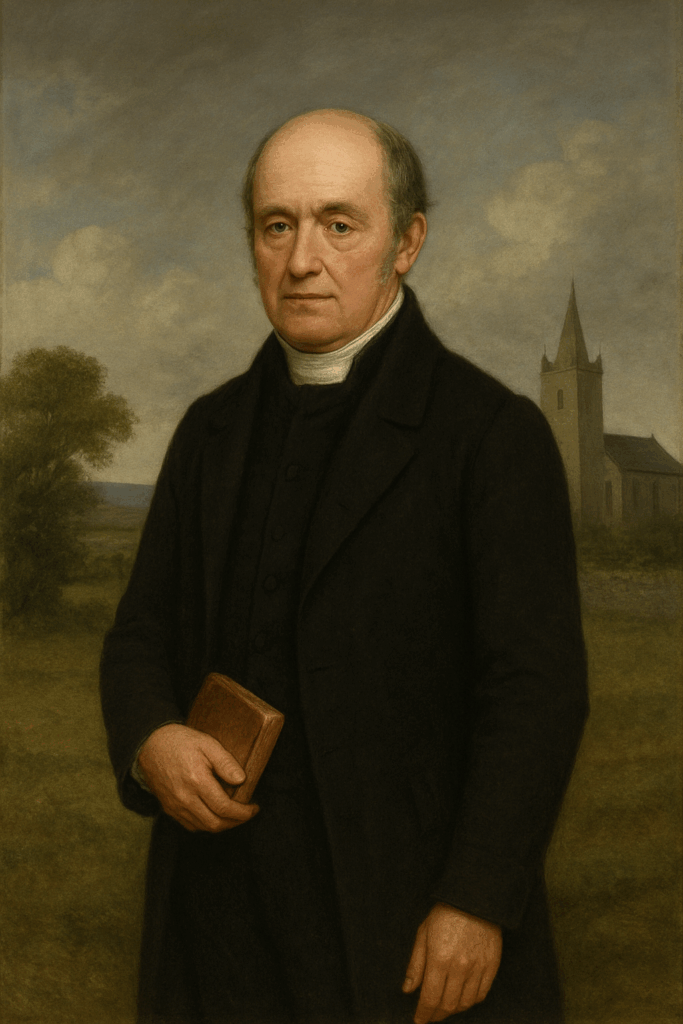
Please note the above image was generated by ChatGPT and is not an actual image of the Rev. Oliver Grace.
I know that Oliver Grace was the resident curate of Kilkeedy Parish in the Kilfenora Diocese of County Clare and that he served as curate for more than 40 years. In addition to his daughter Sarah, he had a son called Thomas.
His brother the Rev. Thomas Grace was the Archdeacon of Ardfert and rector of Westport.
Both the homes of Rev Oliver Grace and Nicholas Bindon Robinson were attacked by the Terry Alts in 1831 during agrarian and sectarian unrest in County Clare and forced to swear illegal oaths. For more details see The Terry Alt Movement.
Subsequent to these attacks the Lord Lieutenant presented the Rev Oliver Grace with a living of £200 a year in the diocese of Elphin, however the Bishop of that See refused to induct him. (Saunders Newsletter,, 25th January 1832).
The Rev Oliver Grace died in Castleblaney in April 1839.
Update 1: From Alumni Dubliennsis (Trinity College Dublin graduates)
Grace, Oliver, Sizar (Rev. Mr. Carey), June 5th, 1780, aged 13; son of Robert, Agricola (Farmer); born Kings County (now Offaly). B.A. AEst 1785.
Grace, Thomas, Pensioner. (Mr. Carey), January 27th, 1787; son of Robert, Mercator (Merchant); born Kings County (now Offaly). [N. F. P.] Scholar. 1790. B.A. Vern. 1791. M.A. Vern. 1796. [Archdeacon of Ardfert].
While not mentioned in Alumni Dubliennsis at some point Thomas received a Doctorate in Divinity.
I would be interested in finding out details of the wife and children of Oliver Grace.
Update 2: I have been contacted by a fellow researcher from Melbourne, Australia. One of his relatives Richard Marrett also married a daughter of the Rev Oliver Grace, whose home has also been raided in 1831 and again in 1833 by the Terry Alts. As she was called as a witness in a subsequent court case we know she was born Frances Grace. Further information from the same source indicates that the Rev Oliver Grace had two other sons in addition to Thomas, Robert and John both of whom served in the constabulary.
Note: https://clarelibrary.ie/eolas/coclare/genealogy/genealog.htm the website above contains many documents listing officials and inhabitants of County Clare that may prove useful to family historians.